This guide reflects the provisions of Federal Decree-Law No. 33 of 2021 and is reviewed for accuracy by an HR and labour law professional. Last updated: July 2026.
How to Calculate Gratuity in UAE: Step-by-Step Formula 2026 (With Examples)
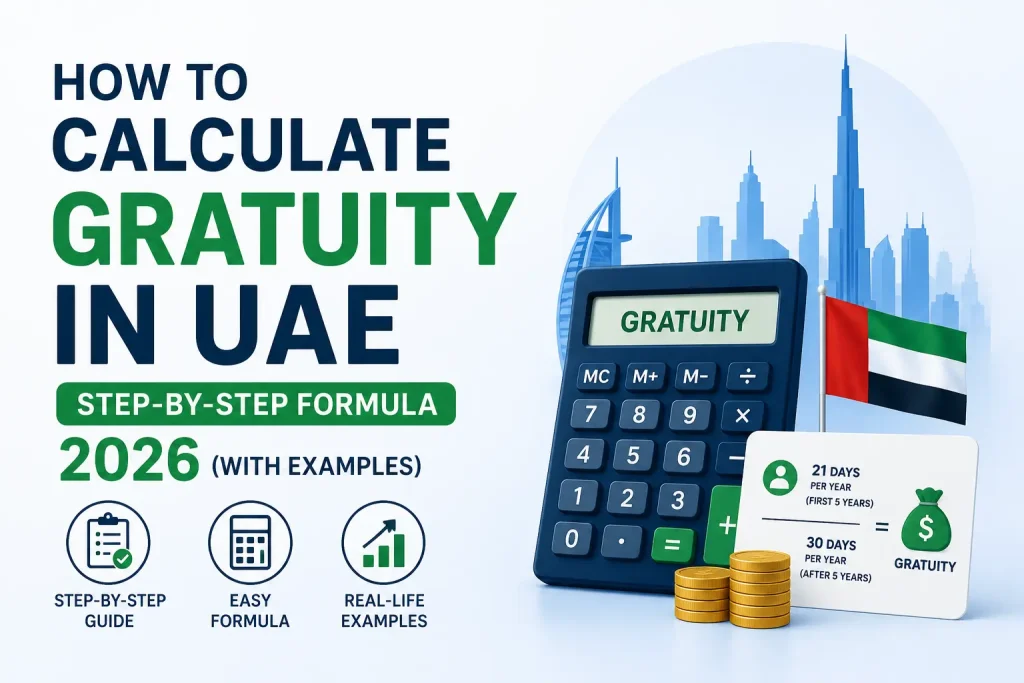
Divide your basic monthly salary by 30 to get your daily wage. Multiply that by 21 days for each of the first 5 years of service, then by 30 days for each year beyond 5. Add both amounts together — that is your gratuity. The total cannot exceed 24 months of your basic salary. You must have completed at least one year of service to qualify.
Most employees in the UAE receive a gratuity payout at some point — but most have no idea whether the amount their employer hands them is accurate. That uncertainty is more common than you’d think, and it’s costly. HR departments make mistakes. Some employers deliberately undercount.
This guide walks you through the exact formula used by the Ministry of Human Resources and Emiratisation (MOHRE) under Article 51 of Federal Decree-Law No. 33 of 2021. By the end, you will know how to verify your own entitlement down to the last dirham — without relying on anyone else’s calculation.
Three real worked examples with actual AED figures are included below, covering different salary levels, service durations, and contract scenarios. If you’d prefer to skip the maths entirely, use our free UAE Gratuity Calculator — it applies the same formula automatically.
- The Legal Basis for Gratuity in UAE
- Who Is Eligible for Gratuity
- Step 1: Identify Your Basic Salary
- Step 2: Calculate Your Daily Wage
- Step 3: Count Your Service Years Accurately
- Step 4: Apply the 21-Day Rule (Years 1–5)
- Step 5: Apply the 30-Day Rule (Beyond 5 Years)
- Step 6: Check the Maximum Cap
- Worked Examples: Three Real Scenarios
- Resignation vs Termination: Does It Change Your Payout?
- What Can Reduce Your Gratuity
- Frequently Asked Questions
The Legal Basis for Gratuity in UAE
Gratuity in the UAE is not a bonus or an employer’s goodwill gesture. It is a legal entitlement — a statutory right enshrined in Federal Decree-Law No. 33 of 2021 Regarding the Regulation of Employment Relationships, specifically under Article 51.
Article 51 requires every private sector employer to pay end-of-service gratuity to any employee who has completed one or more years of continuous service. This applies to UAE nationals and expatriates alike, whether they resign, are terminated, retire, or leave for any other lawful reason.
The law defines both the formula and the minimum entitlement. An employer cannot legally reduce it below what the formula produces — unless a specific legal exemption applies (such as dismissal for gross misconduct under Article 120, or employment through a free zone with its own separate scheme like DIFC’s DEWS system).
In February 2023, unlimited employment contracts were formally abolished. All new and renewed contracts in the UAE private sector are now fixed-term (limited) contracts. Importantly, this change eliminated the old rules that reduced gratuity for employees who resigned early from unlimited contracts. Under the current law, resignation and termination are treated the same way for gratuity calculation purposes — provided you have completed one year of service.
Who Is Eligible for Gratuity
Before running any calculations, confirm that you meet the basic eligibility conditions under UAE law.
- You work in the private sector. Government and public sector employees are covered by different regulations.
- You have completed at least one year of continuous service with the same employer.
- Your employment ended for an eligible reason. Resignation, termination, contract expiry, and retirement all qualify. Dismissal for gross misconduct under Article 120 does not.
- You are not covered by a separate free zone scheme. DIFC and ADGM employees follow different rules.
Part-time employees are also entitled to gratuity under the 2021 law, calculated on a pro-rata basis relative to their working hours compared to a full-time employee in the same role.
Step 1: Identify Your Basic Salary
This is where many employees — and some HR departments — make their first mistake. Gratuity is calculated on your basic salary only, not your total monthly package.
UAE law defines basic salary as the fixed amount agreed in your employment contract, before any additions. The following are explicitly excluded from the gratuity base:
- Housing allowance
- Transport allowance
- Food or meal allowance
- Phone or communication allowance
- Commission payments
- Overtime pay
- Annual bonuses or performance incentives
- Children’s education allowances
Your basic salary is stated explicitly in your employment contract. If you are unsure, check the contract’s salary clause — it typically reads something like: “Basic Salary: AED 8,000 per month” followed separately by allowances.
Your monthly bank transfer is AED 18,000. But your contract shows:
Basic Salary: AED 10,000
Housing Allowance: AED 5,000
Transport Allowance: AED 2,000
Food Allowance: AED 1,000
Your gratuity base is AED 10,000 — not AED 18,000. Using the wrong figure would overestimate your entitlement and cause a dispute with your employer.
If your contract does not separate basic salary from allowances — some older contracts lump everything together — MOHRE’s position is that the entire amount may be considered basic salary. This is worth clarifying with an employment lawyer if the difference is significant.
Step 2: Calculate Your Daily Wage
Once you know your basic monthly salary, divide it by 30.
UAE labour law uses 30 as the standard divisor, regardless of the actual number of days in the month. This is fixed — do not use 26, 28, or 31, even if your company operates on a 26-day working month.
Example: AED 8,000 ÷ 30 = AED 266.67 per day
This daily wage is the building block for everything that follows. A small error here compounds into a significant difference in your final gratuity amount, especially for long-serving employees.
Step 3: Count Your Service Years Accurately
Your service period runs from the date in your employment contract or your actual start date — whichever the contract specifies — to your last working day. Not the date of your termination letter. Not the date your final salary is paid. Your last working day.
Three things reduce your counted service period:
- Unpaid leave days. Any leave taken without pay does not count toward your service period under Article 51. Your employer has the right to subtract these days from the total.
- Authorised career breaks. Extended unpaid career breaks that the employer agreed to in writing may be excluded, depending on the terms agreed at the time.
- Periods of absence without permission. These can be deducted and in some cases trigger separate disciplinary action.
For the formula, you need to express your service duration as a decimal. Here is how to do that:
- Count the total number of days between your start date and your last working day.
- Subtract any unpaid leave days.
- Divide the result by 365 to get years as a decimal (e.g., 6 years and 4 months = 6.33 years).
Start date: 1 March 2019
Last working day: 28 February 2026
Total days: 2,556 (approximately 7 years)
Unpaid leave: 30 days
Adjusted days: 2,526
Service years: 2,526 ÷ 365 = 6.92 years
Step 4: Apply the 21-Day Rule — Years 1 to 5
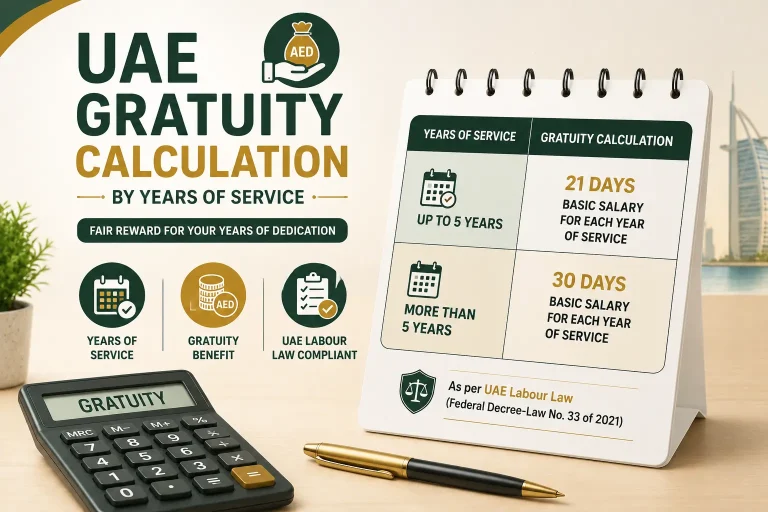
For every year of service in the first five years, you earn 21 calendar days of basic salary. This is the standard rate under Article 51.
If your service is less than five years, apply this formula to your full service duration. If it is more than five years, cap this component at exactly five years and move to Step 5 for the remainder.
Daily wage: AED 15,000 ÷ 30 = AED 500
Gratuity: AED 500 × 21 × 3 = AED 31,500
(No Step 5 needed — service is under 5 years)
Step 5: Apply the 30-Day Rule — Beyond 5 Years
From year six onwards, the rate increases to 30 calendar days of basic salary per year. This higher rate rewards long-serving employees and applies to every additional year above the five-year threshold.
Total Gratuity = Step 4 Amount + Step 5 Amount
Daily wage: AED 8,000 ÷ 30 = AED 266.67
First 5 years: AED 266.67 × 21 × 5 = AED 28,000.35
Year 6: AED 266.67 × 30 × 1 = AED 8,000.10
Total gratuity: AED 36,000.45 (≈ AED 36,000)
Step 6: Check the Maximum Gratuity Cap
UAE law places a ceiling on total gratuity. Under Article 51, your gratuity cannot exceed 24 months of basic salary — that is two full years’ worth of your basic pay, regardless of how long you have worked.
For most employees, the cap will never come into play. It typically only becomes relevant for very long-serving employees or those with unusually high basic salaries relative to their service years. But it is always worth checking.
Basic salary: AED 30,000/month
Maximum gratuity cap: AED 30,000 × 24 = AED 720,000
If the formula produces AED 750,000 after 25 years, you receive AED 720,000 — the cap applies.
Worked Examples: Three Real-World UAE Scenarios
Knowing the formula is one thing. Seeing it applied to actual numbers makes everything click. Here are three different scenarios covering the most common situations employees face.
Example 1: AED 8,000 Salary — 6 Years of Service
- Basic Salary: AED 8,000/month
- Service Period: 6 years exactly (no unpaid leave)
- Contract Type: Limited (standard under current law)
- Reason for Leaving: Resigned (served full notice period)
| Step | Calculation | Amount |
|---|---|---|
| Daily Wage | AED 8,000 ÷ 30 | AED 266.67 |
| First 5 Years (21-day rule) | AED 266.67 × 21 × 5 | AED 28,000.35 |
| Year 6 (30-day rule) | AED 266.67 × 30 × 1 | AED 8,000.10 |
| Total Gratuity | ≈ AED 36,000 | |
| Maximum Cap | AED 8,000 × 24 | AED 192,000 |
| ✅ Cap applies? | No — AED 36,000 is well below cap | |
Final Gratuity Entitlement: AED 36,000
Example 2: AED 15,000 Salary — 3 Years of Service (Termination)
- Basic Salary: AED 15,000/month
- Service Period: 3 years (10 days unpaid leave taken)
- Reason for Leaving: Terminated by employer (no misconduct)
| Step | Calculation | Amount |
|---|---|---|
| Adjusted Service Days | (3 × 365) − 10 = 1,085 days | 2.97 years |
| Daily Wage | AED 15,000 ÷ 30 | AED 500.00 |
| Gratuity (21-day rule) | AED 500 × 21 × 2.97 | AED 31,185 |
| ✅ Final Gratuity | ≈ AED 31,185 | |
Note: The 10 unpaid leave days reduced the service duration slightly, reducing the gratuity by approximately AED 315 compared to a full uninterrupted 3-year service period.
Example 3: AED 6,000 Salary — 8 Years (Resigned, Full Notice Served)
- Basic Salary: AED 6,000/month
- Service Period: 8 years (no unpaid leave)
- Reason for Leaving: Resigned — served full 30-day notice period
| Step | Calculation | Amount |
|---|---|---|
| Daily Wage | AED 6,000 ÷ 30 | AED 200.00 |
| First 5 Years (21-day rule) | AED 200 × 21 × 5 | AED 21,000 |
| Years 6–8 (30-day rule) | AED 200 × 30 × 3 | AED 18,000 |
| Total Gratuity | AED 39,000 | |
| Maximum Cap Check | AED 6,000 × 24 | AED 144,000 |
| ✅ Cap applies? | No — AED 39,000 is below cap | |
Final Gratuity Entitlement: AED 39,000
Note: Under the current law, resigning after serving your notice period gives you the same full gratuity as being terminated. The old unlimited-contract resignation deductions no longer apply.
Our free UAE Gratuity Calculator applies this exact formula to your actual salary and service dates — including unpaid leave deductions. Enter your details and get your result in seconds, with a downloadable PDF report.
Resignation vs Termination: Does It Change Your Gratuity?
Under the current law, the short answer is: not anymore.
Since February 2023, when unlimited contracts were abolished in the UAE, the distinction between resignation and termination for gratuity calculation purposes was effectively removed. Both scenarios now follow the same formula under Article 51 — provided you have completed one year of service and served your notice period.
That said, how you leave still affects a few important things. Here is a clear comparison:
| Factor | Resignation | Termination (Without Misconduct) |
|---|---|---|
| Gratuity Formula | Same as termination (post-2023 law) | 21 days/yr (first 5), 30 days/yr (after) |
| Minimum Service Required | 1 year | 1 year |
| Notice Period Required | Yes — as per contract (typically 30–90 days) | Employer must give notice or pay in lieu |
| Gratuity Impact If Notice Not Served | Employer may deduct unpaid notice pay from gratuity | N/A |
| Gratuity If Dismissed for Misconduct | N/A | Zero — if dismissed under Article 120 |
| Payment Timeline | Within 14 days of last working day | Within 14 days of last working day |
| Work Permit Ban Risk | Possible if you leave without notice and employer reports you | Generally no ban for employees terminated without cause |
If you are navigating a specific situation — perhaps an early resignation from a mid-contract, or a termination you suspect was unfair — our guide on gratuity entitlement after resignation covers those scenarios in detail.
What Can Legally Reduce Your Gratuity
Several situations can result in a lower gratuity payment than the standard formula produces. Knowing these in advance protects you from surprises.
Unpaid Leave
Any days taken as unpaid leave are excluded from your service duration. Employers calculate these precisely, and even a few weeks of unpaid leave can reduce the final payout by a meaningful amount for long-serving employees.
Employer Deductions Under Article 135
Article 135 allows employers to deduct certain amounts from gratuity — but only specific ones:
- Outstanding loan repayments (where the employee borrowed from the employer)
- Salary advances not yet repaid
- Proven damages or losses caused by the employee to company property (must be documented)
Employers cannot deduct non-existent debts, invent disciplinary fines, or reduce gratuity as a general penalty for anything else. If your employer tries to deduct something not listed above, you have grounds for a MOHRE complaint.
Failure to Complete One Year
Employees who leave before their first anniversary receive zero gratuity — no exceptions under the standard law. This applies whether you resign or are terminated before the one-year mark.
Dismissal for Gross Misconduct
Article 120 lists specific grounds on which an employer can dismiss an employee without notice and without gratuity. These include assault on colleagues, repeated serious policy violations, disclosing confidential company information, and a few others. A routine performance-related dismissal does not fall under Article 120 — those employees still receive full gratuity.
For a complete breakdown of when and how employers can legally deduct from your gratuity, see our full guide on the UAE full and final settlement calculation.
Quick Reference: Gratuity Amounts by Salary and Service Years
The table below shows estimated gratuity amounts using the standard formula at four common salary levels. These figures assume no unpaid leave, no cap is reached, and the employee completes the service period indicated.
| Service Years | AED 5,000/mo | AED 8,000/mo | AED 12,000/mo | AED 20,000/mo |
|---|---|---|---|---|
| 1 year | AED 3,500 | AED 5,600 | AED 8,400 | AED 14,000 |
| 2 years | AED 7,000 | AED 11,200 | AED 16,800 | AED 28,000 |
| 3 years | AED 10,500 | AED 16,800 | AED 25,200 | AED 42,000 |
| 5 years | AED 17,500 | AED 28,000 | AED 42,000 | AED 70,000 |
| 7 years | AED 23,500 | AED 37,600 | AED 56,400 | AED 94,000 |
| 10 years | AED 32,500 | AED 52,000 | AED 78,000 | AED 130,000 |
| 15 years | AED 45,000 | AED 72,000 | AED 108,000 | AED 180,000 |
All figures are estimates rounded to the nearest AED. Actual amounts depend on precise service days, unpaid leave, and whether the salary cap applies. Use our calculator for your exact entitlement.
Frequently Asked Questions
How is gratuity calculated in UAE?
UAE gratuity is calculated on your basic monthly salary, divided by 30 to get a daily wage. For the first 5 years of service, you receive 21 days of basic salary per year. For each year beyond 5 years, the rate increases to 30 days. Add both portions together — the total cannot exceed 24 months of basic salary. You need at least one year of continuous service to be eligible.
Is gratuity calculated on basic salary or total salary in UAE?
Basic salary only. Housing allowances, transport allowances, food allowances, commissions, bonuses, and overtime payments are all excluded. Only the fixed basic salary stated in your employment contract is used as the calculation base. This is one of the most common sources of error in gratuity disputes — employees assume their total package is the base, when it is not.
What is the minimum service period to qualify for gratuity in UAE?
One full year of continuous service with the same employer. Employees who leave — for any reason — before completing 12 months of service are not entitled to gratuity under Article 51 of Federal Decree-Law No. 33 of 2021. There are no exceptions for almost-one-year cases; the 12-month threshold is fixed.
Do I get gratuity if I resign in UAE?
Yes, as long as you have completed one year of service. Since February 2023, when unlimited contracts were abolished under UAE law, the old rules that reduced gratuity for resigned employees no longer apply. Today, resignation and termination follow the same gratuity formula. You receive full gratuity provided you have served your notice period correctly.
When must my employer pay my gratuity?
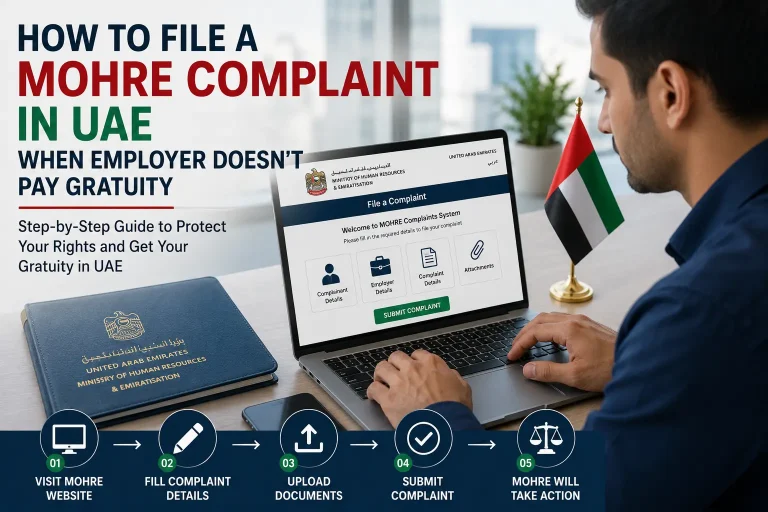
UAE law requires employers to pay all end-of-service entitlements — including gratuity — within 14 days of your last working day. If payment is delayed beyond this, you can file a complaint with MOHRE at mohre.gov.ae or through the MOHRE app. Employers found to have delayed payment without justification face financial penalties.
Can my employer deduct from my gratuity?
Only in specific circumstances allowed under Article 135. Legal deductions include outstanding loans or salary advances taken from the employer and proven, documented losses caused to company property. Employers cannot invent debts or use gratuity as a general disciplinary tool. Any deduction you believe is unjustified can be contested through MOHRE’s dispute resolution process.
The Formula in Summary
Calculating your UAE gratuity comes down to six steps:
- Confirm your basic monthly salary (not your total package)
- Divide by 30 to get your daily wage
- Count your service years precisely, minus any unpaid leave
- Multiply daily wage × 21 × years for the first 5 years
- Multiply daily wage × 30 × years for everything beyond 5
- Check that the total does not exceed 24 months of basic salary
The formula itself is straightforward. The complications usually come from salary confusion, unpaid leave miscounting, or an employer applying outdated rules. Now that you know the correct method, you can verify any gratuity offer you receive — and push back confidently if the numbers do not add up.
If you work in JAFZA or another major free zone and want to confirm whether your situation follows the standard formula, our JAFZA Gratuity Calculator covers the free zone-specific rules in detail.
Enter your salary, start date, end date, and reason for leaving. Our calculator applies Article 51 automatically — with support for unpaid leave, working days, and a downloadable PDF report you can keep for your records.
→ Calculate My Gratuity NowDisclaimer: This guide is for informational purposes and reflects the provisions of Federal Decree-Law No. 33 of 2021. It does not constitute legal advice. For complex situations — disputed terminations, misconduct allegations, or free-zone employment — consult a qualified UAE employment lawyer. Official MOHRE guidance is available at mohre.gov.ae.