How to File a MOHRE Complaint in UAE When Employer Doesn’t Pay Gratuity
Reviewed under Federal Decree-Law No. 33 of 2021 | Last updated: July 2026
Your last working day has passed. Two weeks have gone by. Your gratuity has not arrived. Your messages to HR are being ignored. You know you are legally owed the money — but you are not sure what to do next.
This guide is written for exactly that situation. Filing a complaint with MOHRE — the Ministry of Human Resources and Emiratisation — is the official legal route to recover unpaid gratuity or any other end-of-service entitlement in the UAE. The process is free, structured, and more straightforward than most employees expect.
This article walks you through every step: when you have the right to complain, what documents to gather, how to file by each available method, what happens after you submit, and what to do if the employer still refuses to pay.
Before filing, confirm the exact amount owed using our free UAE Gratuity Calculator — having your calculation ready before you submit strengthens your case considerably.
Table of Contents
- When Can You File a MOHRE Complaint?
- Before You File: Send a Written Request First
- Documents You Need Before Filing
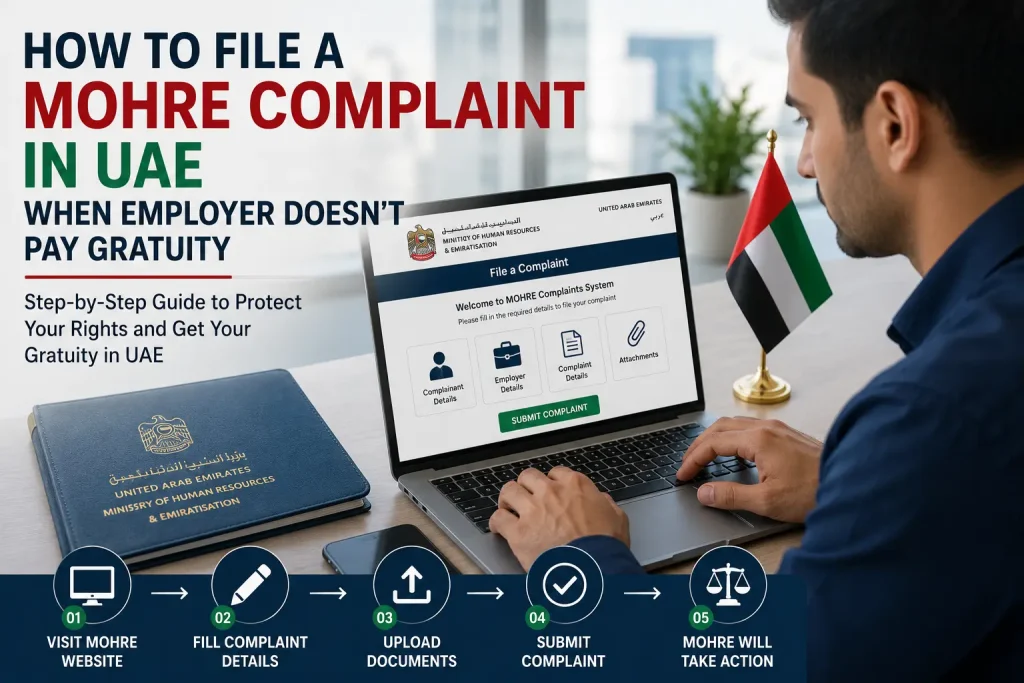
- Method 1: Filing Online via the MOHRE Website
- Method 2: Filing via the MOHRE App
- Method 3: Filing in Person at a MOHRE Service Centre
- What Happens After You File?
- The Conciliation Session: What to Expect
- If Conciliation Fails: The Labour Court
- Realistic Timeline from Filing to Resolution
- Tips to Strengthen Your Complaint
- Frequently Asked Questions
When Can You File a MOHRE Complaint?
The legal basis for filing a MOHRE complaint about unpaid gratuity is Article 53 of Federal Decree-Law No. 33 of 2021, which requires employers to pay all end-of-service entitlements within 14 calendar days of the employee’s last working day.
This means your right to complain formally activates on day 15 — if you have not received payment by then. You do not need to wait longer. You do not need a specific reason why the employer has not paid. The deadline missed is sufficient grounds.
You can also file a MOHRE complaint in the following situations even if 14 days have not passed:
- Your employer has paid you but the amount is less than what the law requires
- Your employer has made unlawful deductions from your gratuity or final settlement
- Your employer has terminated you and refused to provide a written notice or settlement breakdown
- You have been dismissed and believe it was arbitrary or based on grounds that do not qualify under Article 44
There is one important limitation: UAE labour law has a limitation period for bringing complaints. Claims must generally be brought within one year of the date the right arose. Do not delay filing if you believe you are owed money — the longer you wait, the more difficult it becomes to enforce your rights.
Before You File: Send a Written Request First
Before submitting a formal MOHRE complaint, it is worth sending one written request directly to your employer. This is not a legal requirement — you can go straight to MOHRE — but it serves several practical purposes.
First, many delayed payments are the result of administrative issues, processing delays, or HR errors rather than deliberate refusal. A clear, written request citing the 14-day legal deadline sometimes resolves the matter within days.
Second, the written record of your request and the employer’s response — or non-response — becomes useful evidence when you do file the complaint. MOHRE conciliators and Labour Court judges consider the communication history between the parties.
Send the request by email to your HR contact and copy your direct manager. State clearly:
- Your last working day
- The 14-day deadline under Article 53 and the date it passed
- The specific components of the settlement you have not received
- Your calculated total amount owed
- A request for payment within 3 to 5 working days
If the employer does not respond or respond adequately within that window, proceed to file the MOHRE complaint.
Documents You Need Before Filing
Having your documents ready before you begin the filing process makes the submission faster and the complaint stronger. Gather the following:
| Document | Why It Is Needed |
|---|---|
| Employment contract (signed copy) | Proves employment relationship, salary, start date, contract type |
| Payslips or salary bank transfer records | Confirms actual salary received and pay history |
| Resignation letter (if you resigned) | Establishes last working day and confirms proper notice was given |
| Termination letter (if you were terminated) | Establishes last working day and reason for termination |
| Emirates ID (front and back) | Required for identity verification in all MOHRE processes |
| Passport copy | Required for expatriate workers — confirms identity and visa status |
| Your settlement calculation | Shows the amount owed — use our calculator to produce this figure |
| Any written communication with the employer about settlement | Demonstrates you attempted to resolve the issue before filing |
| Employer’s trade licence number (if known) | Helps MOHRE locate and contact the employer |
If you do not have your employment contract — for example if you never received a copy — you can request it through MOHRE as part of the complaint process. MOHRE has access to labour contract records registered with the ministry.
Method 1: Filing Online via the MOHRE Website
The MOHRE website at mohre.gov.ae is the most accessible way to file a complaint and is available 24 hours a day.
Step 1: Go to mohre.gov.ae and navigate to the Services section. Look for “Labour Complaints” or “File a Complaint.”
Step 2: You will be asked to log in or register using your UAE Pass digital identity, Emirates ID number, or mobile number linked to your national ID. UAE Pass is the preferred authentication method and is free to set up.
Step 3: Select the complaint category. For unpaid gratuity, this typically falls under “End of Service Benefits” or “Wages and Salaries.” Choose the most accurate category matching your situation.
Step 4: Fill in the complaint form. You will be asked for:
- Your personal details (auto-filled from UAE Pass if using it)
- Employer name, trade licence number, and location
- Your employment start and end dates
- Your basic salary and total salary
- A description of what has not been paid and the amount owed
Step 5: Upload your supporting documents. The system accepts PDF and image files. Upload your contract, payslips, resignation or termination letter, and your settlement calculation.
Step 6: Submit and note your complaint reference number. Keep this number — you will need it to track the status of your complaint and attend the scheduled conciliation session.
Method 2: Filing via the MOHRE App
The MOHRE app is available for free download on both the Apple App Store and Google Play Store. It provides the same complaint functionality as the website in a mobile-friendly format.
Step 1: Download the official MOHRE app. Search for “MOHRE” in the App Store or Google Play. The official app is published by the UAE Ministry of Human Resources and Emiratisation.
Step 2: Log in using UAE Pass, Emirates ID, or your registered mobile number. If you have not set up UAE Pass, you can register through the UAE Pass app using your Emirates ID and a selfie for facial recognition.
Step 3: Navigate to the Complaints section within the app. Select “New Complaint” and choose the relevant complaint type — end of service, wages, or gratuity.
Step 4: Complete the complaint form with your employer details, employment dates, salary information, and a clear description of the unpaid amount.
Step 5: Attach your documents by photographing them or uploading saved files from your phone. Submit the complaint and save the reference number.
The app allows you to track the status of your complaint in real time, receive notifications about scheduled conciliation dates, and communicate with MOHRE directly without visiting a service centre.
Method 3: Filing in Person at a MOHRE Service Centre
If you prefer to file in person — or if you need assistance with the process — MOHRE operates service centres across all seven emirates. Staff at these centres can help you complete the complaint form and submit documents.
What to bring:
- Original Emirates ID
- Passport
- Employment contract (original or clear copy)
- Payslips or bank transfer records
- Resignation or termination letter
- Your written settlement calculation
- Any correspondence with the employer
What to expect: A MOHRE officer will review your documents, help you complete the complaint form, and register the complaint in the system. You will receive a reference number and be informed of the next steps, including when the conciliation session will be scheduled.
MOHRE service centres operate during standard government working hours — typically Sunday to Thursday, 7:30am to 3:30pm. Check the MOHRE website for the nearest centre to your location and its specific opening hours, as these can vary.
What Happens After You File?
Once your complaint is submitted — by any method — MOHRE registers it in the system and the following process begins automatically.
MOHRE will contact the employer, informing them that a complaint has been filed against them and requesting their response. The employer is required to engage with the process. Employers who ignore MOHRE correspondence face escalation to the Labour Court without any further conciliation opportunity.
Within a few working days of registering the complaint, MOHRE will schedule a conciliation session. Both parties — the employee and an authorised representative of the employer — will be asked to attend on a specific date and time. You will be notified of this date by SMS, email, or through the MOHRE app.
The complaint will be assigned to a MOHRE conciliator, who will review the documents, listen to both sides, and attempt to mediate a settlement. The conciliator has the authority to determine what UAE law says is owed and to recommend a resolution amount — but they cannot issue a binding court order. That authority lies with the Labour Court.
The Conciliation Session: What to Expect
The conciliation session is a formal meeting at MOHRE between you, an employer representative, and a MOHRE conciliator. It typically lasts between 30 minutes and 2 hours depending on the complexity of the dispute.
Bring all your original documents to the session. Be prepared to explain your situation clearly: when your employment ended, what you were paid, and what you believe remains unpaid. Present your calculation showing the difference between what you received and what you are legally owed.
The conciliator will review both sides and attempt to broker an agreement. Possible outcomes include:
| Outcome | What Happens Next |
|---|---|
| Employer agrees to pay full amount | Case closed — payment made within agreed timeframe (typically 3–7 days) |
| Employer agrees to pay a reduced amount | If you accept the compromise, case closed. If not, referred to Labour Court |
| Employer disputes the amount but negotiates | Conciliator may schedule a second session or refer to Labour Court |
| Employer refuses to attend or cooperate | Case automatically referred to Labour Court — no further MOHRE session needed |
| Conciliation fails — no agreement reached | MOHRE issues a referral letter — case proceeds to Labour Court |
Do not feel pressured to accept a settlement at conciliation that is significantly lower than what you are legally owed. The Labour Court will apply the full formula and award the correct legal amount. Accepting a reduced settlement at conciliation in exchange for a faster resolution is a personal choice — but you are not obligated to do so.
If Conciliation Fails: The Labour Court
If MOHRE conciliation does not produce an agreement, MOHRE issues a referral letter authorising you to take the case to the Labour Court. This letter is the document you need to initiate court proceedings.
The Labour Court process for employment disputes in the UAE is designed to be accessible to workers. Key points:
- Cases involving amounts below a certain threshold may be handled through a simplified fast-track process
- The judge will apply UAE labour law directly to the facts of the case
- The employer bears a significant burden of proving that they have paid correctly — if they cannot produce payment records, the employee’s version is generally accepted
- Employers found to have failed to pay within 14 days without justification face financial penalties on top of the outstanding amount
- Court proceedings are conducted in Arabic — having an Arabic-speaking legal representative is advisable for complex cases
For clear-cut cases — such as an employer who simply has not paid a calculable gratuity amount — Labour Court judgments often go in the employee’s favour when the documentation is in order. The court’s role is to apply the law, and the law is clear on what employees are owed.
Realistic Timeline from Filing to Resolution
| Stage | Typical Duration |
|---|---|
| Filing the complaint | Same day — online, app, or in person |
| MOHRE contacts employer | 1–3 working days after filing |
| Conciliation session scheduled | Usually within 5–10 working days of filing |
| Conciliation session held | Within 2–3 weeks of filing |
| Resolution at conciliation | Payment within 3–7 days of agreement |
| Labour Court referral (if conciliation fails) | Referral letter issued within a few days |
| Labour Court judgment | Varies — typically 2 to 6 months for straightforward cases |
The most efficient resolution is at conciliation. If the employer’s failure to pay is clearly documented and the amount is straightforward, many cases are resolved within 3 to 4 weeks of the initial complaint. Disputed terminations or cases involving contested amounts take longer.
Tips to Strengthen Your Complaint
A well-prepared complaint moves faster, is harder for the employer to contest, and results in a stronger position at both conciliation and court. The following practical steps make a significant difference.
Calculate Your Amount Before Filing
Present a clear, itemised calculation of what you are owed — gratuity broken down by years, outstanding salary for specific days, leave encashment for specific days, and any other components. Vague claims of “I am owed money” are harder to conciliate than “I am owed AED 42,000 in gratuity calculated as follows.” Use our gratuity calculator to produce a printable result you can attach to your complaint.
Preserve All Written Communication
Screenshot or save every email, WhatsApp message, or other written exchange with the employer about your settlement. Date-stamped communication showing the employer acknowledged the debt but did not pay is powerful evidence.
Keep Your Own Records of Working Days
If there is a dispute about your last working day or unpaid leave days, your own records — emails from that period, calendar entries, access card logs if you can obtain them — can support your position.
Do Not Sign Anything Under Pressure
If your employer presents a settlement document that shows a lower amount than you are owed and pressures you to sign it, do not. Signing a full and final settlement acknowledgement significantly limits your ability to claim more later. Always verify the figures first.
File Before Leaving the UAE
If possible, file the MOHRE complaint before your visa expires and you leave the country. In-person attendance at conciliation is normally required, and filing from abroad through a representative is more complicated. Act before your departure if payment has not been made.
Frequently Asked Questions
How do I file a MOHRE complaint against my employer in UAE?
You can file a MOHRE complaint in three ways: online at mohre.gov.ae, through the MOHRE mobile app (iOS and Android), or in person at any MOHRE service centre. All three methods are free and lead to the same process. You will need your employment contract, payslips, resignation or termination letter, Emirates ID, and your own calculation of the amount owed. After filing, MOHRE schedules a conciliation session within about two weeks.
How long does a MOHRE complaint take to resolve in UAE?
If the dispute is resolved at conciliation, the full process typically takes 3 to 4 weeks from filing to receiving payment. If conciliation fails and the case goes to the Labour Court, the timeline extends to several months. Clear, documented claims with strong evidence tend to resolve faster. Complex cases involving disputed termination grounds or contested calculations take longer.
Is there a fee to file a MOHRE complaint in UAE?
No. Filing a complaint with MOHRE is completely free for employees. There are no application fees and no charges for the conciliation session. If the case proceeds to the Labour Court, standard court fees may apply at that stage — but the initial MOHRE process costs the employee nothing.
Can I file a MOHRE complaint after leaving the UAE?
Filing after leaving the UAE is significantly more difficult because in-person attendance at conciliation is normally required. If you have already departed, you can appoint a legal representative based in the UAE to act on your behalf. It is strongly advisable to file before you leave if your gratuity remains unpaid. MOHRE complaints have a one-year limitation period from when the right to claim arose.
What happens if my employer ignores the MOHRE complaint?
If the employer fails to respond to MOHRE or refuses to attend the conciliation session, MOHRE does not simply close the case. Instead, it refers the complaint directly to the Labour Court. The employer cannot ignore the process — non-cooperation has legal consequences, and the Labour Court can order payment of the full amount owed plus penalties for the delay under Article 53 of Federal Decree-Law No. 33 of 2021.
Key Points: Filing a MOHRE Complaint at a Glance
- You can file a MOHRE complaint if gratuity is not paid within 14 days of your last working day
- Filing is free — no fees for employees at any stage of the MOHRE process
- Three filing methods: website, app, or in-person — all equally valid
- Conciliation is typically scheduled within 2 to 3 weeks of filing
- If conciliation fails, the case moves to Labour Court — no further action needed from you to trigger this
- Employers who ignore the process face court referral and financial penalties
- File before leaving the UAE — in-person attendance at conciliation is normally required
- Bring a clear, itemised calculation of what you are owed — it strengthens your case significantly
Before you file, confirm exactly what you are owed using our free UAE Gratuity Calculator. Enter your basic salary and service dates to get a precise, printable calculation you can attach to your MOHRE complaint.
For a full explanation of what should be included in your final settlement beyond just gratuity, see our guide on full and final settlement in UAE.
Disclaimer: This article is for informational purposes and reflects Federal Decree-Law No. 33 of 2021 as in force in July 2026. It does not constitute legal advice. For complex employment disputes or cases involving wrongful termination, consult a qualified UAE employment lawyer before or alongside filing a MOHRE complaint.